
 Domestic TMS
 International TMS
 Technology Platform

 Consumer Products
 Retail
 Automotive
 Chemicals
 Pharmaceuticals
 Reduce Freight Costs
 Orchestrate Global Trade Management
 Improve Customer Experience
 Digitalise Supply Chain Execution





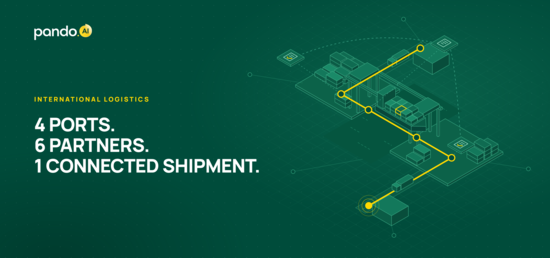
The Four-Port Problem
An enterprise moves import and export shipments through four ports. Six logistics partners are involved: a freight forwarder at origin, a customs broker handling origin clearance, a shipping carrier on the ocean leg, a drayage operator at the destination port, a customs broker at destination, and a final-mile carrier. Updates arrive through email threads, shared spreadsheets, phone calls, and separate partner portals.
A shipment may have left the origin port, but the operations team is still waiting on confirmation from the freight forwarder. No one knows whether the bill of lading has been issued, whether the destination customs broker has been notified, or whether the delivery window is still intact.
How can enterprises create a connected view of international shipments across every leg?
Why Multi-Leg EXIM Visibility Breaks Down
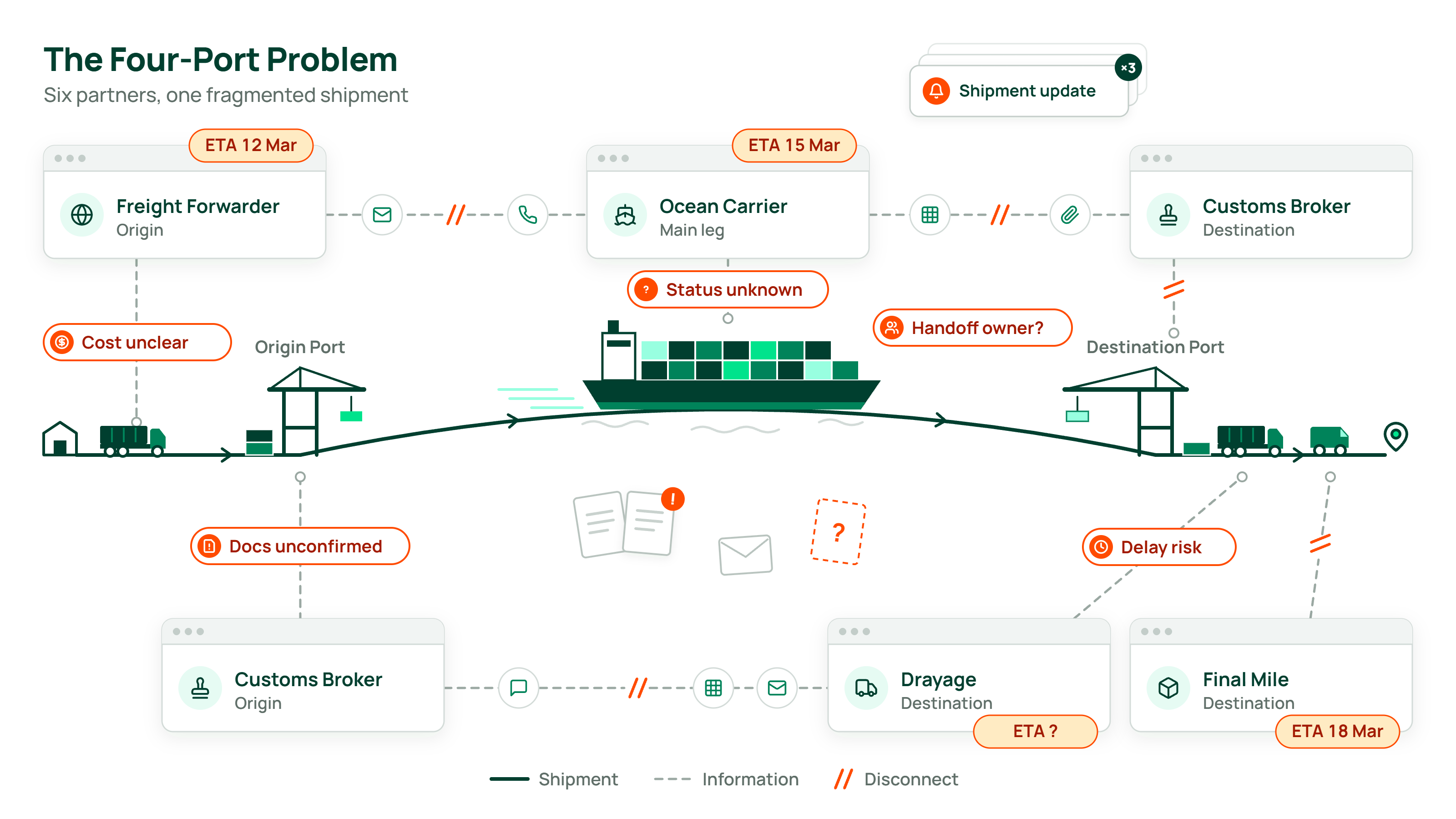
International shipments involve multiple operational stages, each owned by a different party, each reporting in a different format and on a different timeline. The visibility gap grows with every handoff.
Five specific challenges compound this:
-
Fragmented updates across partners. Each logistics partner operates its own system. One sends a daily email summary, another updates a spreadsheet, a third requires a phone call. Milestone reporting is inconsistent in timing, format, and completeness.
- Unclear ownership at handoff points. When a shipment moves from ocean freight to destination customs clearance, the next responsible action is not always obvious. Delays compound when accountability is ambiguous.
- Documentation scattered across channels. Bills of lading, packing lists, certificates of origin, and customs declarations may sit across email inboxes, partner portals, and local drives. Teams spend considerable time chasing documents that should already be accessible.
- No common operating picture. Without a shared platform, operations teams assemble a manual view from partner emails and status calls. That view is always slightly out of date and difficult to act on.
- Limited financial visibility. Freight accruals across individual legs are difficult to track in real time, making it hard to identify cost overruns before invoicing or to understand the full cost of a delayed shipment.
The result is reactive management. Teams identify exceptions only when a partner reports a problem, rather than acting before the impact reaches the next leg.
What Is Multi-Leg EXIM Shipment Visibility?
Multi-leg EXIM shipment visibility is the ability to monitor shipment progress, milestones, responsible stakeholders, documentation status, and freight cost information across the connected stages of an international import or export shipment.
Meaningful visibility covers five dimensions:
Shipment-level visibility across the complete journey from origin to final delivery, treated as a connected sequence rather than isolated events.
Leg-level milestones, status updates, and ETAs at each operational stage, capturing what has happened and what is expected next.
Clear ownership of the next action at each handoff, assigned to the responsible logistics partner.
Accessible documentation including shipping and customs documents relevant to each leg.
Financial visibility into freight accruals and costs across individual legs.
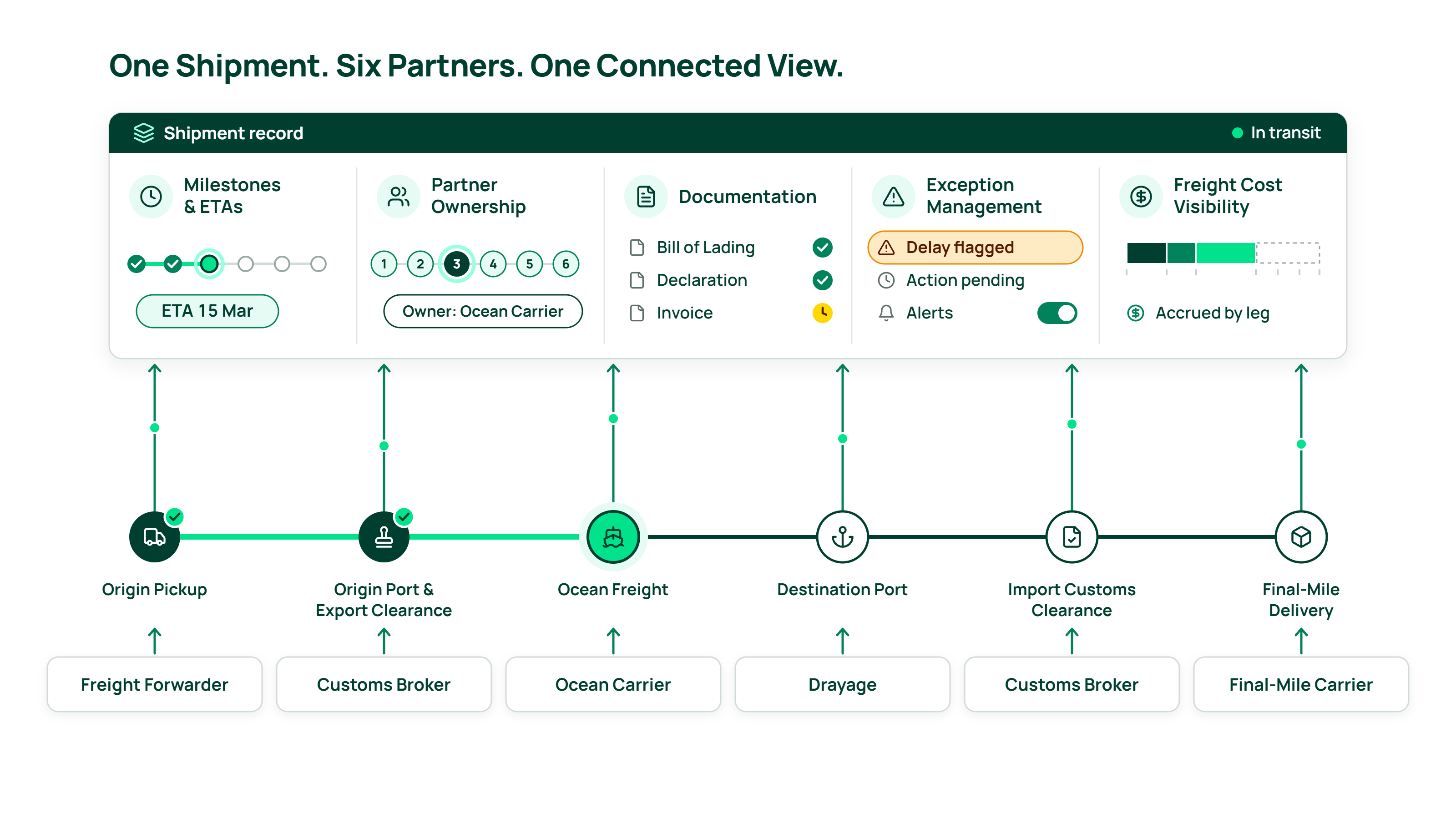
A typical international shipment passes through origin pickup, origin port handling and customs export clearance, ocean freight, destination port handling, destination customs import clearance, and final-mile delivery. The actual structure varies by route, trade terms, shipment configuration, and operating model. What matters is that each stage is tracked as part of a connected journey, not in isolation.
How Enterprises Can Build Multi-Leg EXIM Visibility
Step 1: Map Every Leg and Assign Ownership
Define each shipment leg and the party responsible for it before the shipment moves. This includes identifying whether the service is provided by an internal team or an external partner: transporters, drayage partners, freight forwarders, customs brokers, agents, or shipping carriers. Configure the checkpoints and information required at each stage.
This structure creates accountability at every handoff. When a delay occurs, the operations team knows exactly who owns the current leg and what action or information is outstanding.
Step 2: Standardise Shipment Milestones and Updates
Record shipment progress against defined milestones at each leg. A common operating view where milestones, status updates, and ETAs are captured in one place is more useful than assembling updates from disconnected partner messages.
Milestone-level visibility and estimated ETAs are not the same as live GPS tracking across every international leg. On ocean movements, vessel tracking provides position data. On road legs, GPS, SIM-based, or app-based tracking may apply depending on geography and carrier capability. Being precise about which update type applies at each leg prevents operational misreads.
Step 3: Connect Logistics Partners Through Shared Workflows
A shared collaboration platform allows each logistics partner to access and update the shipment information and documentation relevant to their assigned role. A freight forwarder sees what they need; a customs broker sees their portion; a final-mile carrier sees theirs.
This approach reduces repeated follow-ups, makes the next responsible action visible to both the operations team and the relevant partner, and creates a record of what was communicated and when.
Step 4: Connect Visibility With Documentation and Exception Management
Milestone tracking is more useful when the relevant shipping and customs documents are accessible alongside the operational status. Collaborative document management, anomaly detection for document errors, and configurable exception alerts help teams identify issues before they cascade downstream.
Where supported, predictive ETAs can inform decisions about in-transit rerouting or alternate-mode options. The objective is to give teams the information to act earlier, not to promise that disruptions can always be prevented.
Step 5: Connect Shipment Visibility With Freight Costs
Visibility should extend beyond operational status. Freight accrual visibility at every shipment leg, combined with shipment data integrated with freight audit, multi-currency support, and multimodal optimisation across cost, transit time, SLAs, and emissions gives operations teams the information to make decisions rather than simply track events.
How an International TMS Supports This Operating Model
An International Transportation Management System (International TMS) is a software platform that manages the planning, execution, visibility, documentation, and cost management of international shipments across multiple transport modes and logistics partners.
An effective International TMS brings together:
Multi-leg shipment planning and execution Carrier and freight forwarder collaboration Shipment milestone tracking and ETAs Documentation and compliance workflows Exception management and configurable alerts Freight accrual and shipment cost visibility
Pando's International TMS is built to support this connected operating model. The platform allows enterprises to configure each shipment leg, assign the responsible stakeholder at each stage (whether an internal team or an external logistics partner), and give each partner access to the shipment information and documentation relevant to their role. Multiple vendors can view and update information specific to their leg within a single shipment record.
Pando supports order consolidation across global multi-leg shipments, multimodal planning and optimisation, real-time milestone visibility, collaborative document management with anomaly detection, automated HS code classification and HAZMAT labelling, vessel tracking for ocean movements, and freight accrual visibility at every leg. Shipment data integrates with Pando's freight audit module, supporting end-to-end freight spend visibility.
What Enterprises Should Look for in an International TMS
When evaluating an International TMS for multi-leg EXIM visibility, ask:
-
Can the system represent a shipment as multiple connected legs, each with its own milestone structure?
-
Can responsibilities be assigned to different logistics partners at each leg?
-
Can relevant partners access and update shipment information based on their assigned role?
-
Does the system support milestone-level visibility and ETAs, and distinguish between live tracking, milestone updates, and predictive estimates?
-
Can teams manage shipping and customs documentation collaboratively within the platform?
-
Can the platform surface configurable exceptions, delays, and pending actions?
-
Can freight accruals and shipment costs be viewed at individual leg level?
-
Can it integrate with existing ERP, OMS, and enterprise systems?
The Journey Is One Shipment, Not Six Updates
Multi-leg EXIM shipment visibility is not just about knowing where a container is. It requires a connected view of what has happened at each leg, who is responsible for the next action, whether documentation is in order, and how delays or cost implications affect downstream operations.
An International TMS creates that connected view by bringing together shipment planning, partner collaboration, milestone visibility, documentation, exception management, and freight cost data in one operating model.
If your team is still coordinating international shipments across multiple partners through email threads and spreadsheets, explore how Pando's International TMS supports end-to-end planning, execution, visibility, and collaboration across every leg of the journey. [Request a demo or speak with a Pando solutions specialist.]
FAQ
Q1: What is multi-leg shipment visibility? Multi-leg shipment visibility is the ability to monitor a shipment's progress, milestones, responsible stakeholders, documentation status, and freight costs across each connected stage of an international journey. It treats an entire import or export shipment as one connected sequence rather than a series of separate carrier or partner updates.
Q2: How does an International TMS improve EXIM visibility? An International TMS gives enterprises a single operating platform to configure each shipment leg, assign partner responsibilities, track milestones and ETAs, manage shipping and customs documentation, and monitor freight costs across legs. It replaces fragmented coordination across email and partner systems with a shared, structured workflow.
Q3: What is the difference between shipment tracking and end-to-end visibility? Shipment tracking typically means knowing the current location or status of a container or vehicle. End-to-end visibility covers the full picture across an international shipment: what has happened at each leg, what documentation is available, who owns the next action, whether exceptions require attention, and what the freight cost implications are at each stage.
In this article..
Subscribe to our blog now!
Stay up to date with the latest logistics, transportation, and supply chain tips and news.