ERP Transport Module vs TMS: How Enterprises Decide
Published on November 12, 2026 • 21 mins read
Pooja Radhakrishnan
At some point, every enterprise running SAP, Oracle or Microsoft Dynamics has this meeting. Logistics wants a transportation management system (TMS). IT points out that the ERP already has a transport module, and that a new platform means another integration, another vendor and another budget line.
Both sides are right about something. That is why the decision can stall for quarters.
The better question is not "ERP or TMS". It is which system should own which decision. This guide gives supply chain and IT leaders a shared way to answer that.
The short answer: Extend the ERP module when transport is low-volume, single-mode and run mostly by your own team. Buy a TMS when carriers, plants and finance all need to act on the same shipment, when you tender or re-plan every day, or when freight invoices are still checked by hand. Either way, the ERP stays the system of record. What changes is which system runs execution.
What an ERP transport module is built to do
An ERP transport module is designed to record transport against the order, not to run it. In SAP, that has meant shipment documents in LE-TRA on ECC and freight orders in S/4HANA Transportation Management.
It does three things well. It ties every shipment to a sales order, delivery and material. It posts freight cost to the right cost centre. And it keeps the books clean.
It was never designed for the work that happens outside your own walls: asking 40 transporters for a rate at 4 pm, getting a truck placed by 7 am, chasing proof of delivery (POD), and checking whether the invoice matches the contract. That work involves people who will never log in to your ERP.
ERP vs TMS
Two systems. Two different responsibilities.
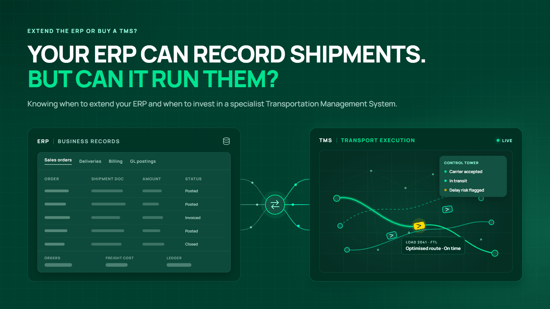
An ERP maintains business records and financial integrity. A specialist TMS manages transportation execution and collaboration across the logistics ecosystem.
Business records
ERP transport module
Designed to maintain business records and connect transportation costs to enterprise operations.
Order management
Shipment documentation
Freight cost posting
Financial records
Master data management
Internal workflows
Transport execution
Specialist TMS
Designed to manage the operational complexity of transportation across carriers, locations and partners.
Load planning and optimisation
Carrier tendering
Freight procurement
Shipment tracking and visibility
Proof of delivery
Freight audit and reconciliation
When should you make the move?
Fewer than 10 carriers.
Fixed routes and contracts.
Low shipment complexity.
Limited freight audit requirements.
One mode and one country.
What this suggests
Your existing ERP may be sufficient.
Multiple carriers and frequent spot procurement.
Complex load planning.
Manual freight invoice auditing.
Multiple transport modes.
Multi-country operations.
What this suggests
Your transportation operation may need a dedicated execution platform.
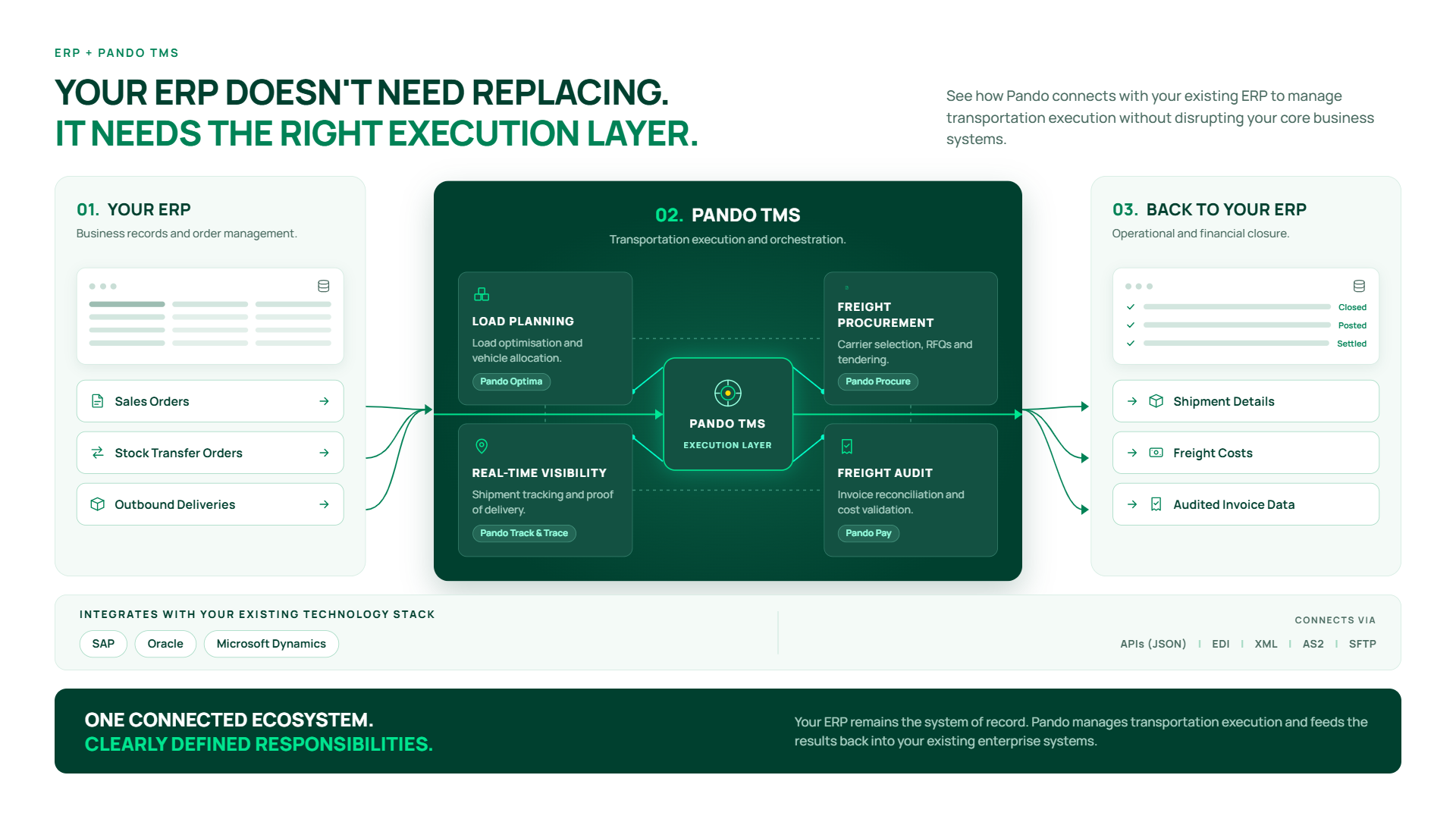
The connected model
ERP
Sends
Orders
Stock transfers
Deliveries
Pando TMS
Manages
Planning
Tendering
Tracking
POD
Freight audit
ERP
Receives
Shipment details
Freight costs
Audited invoice data
A specialist TMS does not replace your ERP. It extends your execution capabilities while your ERP remains the system of record.
Why SAP users need to decide now
For SAP customers, this is no longer a decision you can defer indefinitely. LE-TRA's usage rights under the S/4HANA compatibility scope end on 31 December 2030.
The replacement inside S/4HANA comes in two tiers:
Transportation Management (formerly Basic Shipping) is included in the S/4HANA licence and broadly covers what LE-TRA did. Engine-based functions are not part of it.
So "just extend the ERP" often means a migration project and, for anything beyond basic shipping, a new licence. Either way, you are buying something. The real choice is what.
Five signs you have outgrown the ERP transport module
1. Your carriers work outside the ERP
Transporters do not log in to SAP. So indent acceptance, vehicle placement and POD happen over phone, email and WhatsApp, and someone keys the results back in. The ERP shows what was recorded, not what actually happened.
A TMS gives carriers their own portal or mobile app. After moving spot RFQs, placement and POD onto a shared workflow, a leading personal-care manufacturer cut spot RFQ time to 30 to 45 minutes and gained 100% visibility into detention charges.
2. Your planning has more constraints than the module can hold
Choosing the right truck mix by both weight and volume, consolidating loads on a route and pulling future dispatches forward to fill a truck is optimisation work. Basic ERP shipping is not built for it.
A leading consumer durables manufacturer that moved load planning into a TMS raised its full-truckload share from 69% to 86%, with 94% of shipments now system-planned.
3. Freight procurement runs on spreadsheets
If every RFQ is an Excel file emailed to the same carriers, you have no market benchmark and no way to discover new capacity. A leading consumer health company that ran procurement events in Pando discovered 174 new carriers, benchmarked 195 lanes and saved INR 2.2 crore.
4. Freight invoices are checked by hand
Auditing an invoice properly means a four-way match: purchase order, contracted rate, shipment data and POD. ERP modules post the cost but rarely run that match at volume. A leading electrical appliances manufacturer reached an 89% first-time match rate and full freight spend visibility after automating it. (For what match rate to expect, see our freight audit match-rate benchmark.)
5. You run more than one mode or country
Domestic road freight, ocean imports and air exports each have their own partners, documents and milestones. Once a shipment crosses ports and forwarders, an ERP shipment record cannot show where it actually is. Our guide to multi-leg EXIM shipment visibility covers this in depth.
The real cost of each path
Licence price is the smallest line in this comparison. What matters is who builds, who maintains and who gets left outside the system.
Cost driver
Extend the ERP module
Buy a specialist TMS
Licence
Basic TM is included in S/4HANA; Advanced TM is a separate licence
Subscription
Build effort
Custom development and SI consultants for portals, rate engines and mobile POD
Configuration, plus integration to the ERP
Carrier access
Needs an external portal or extra user access, so it often stays manual
Carrier portal and mobile app included
Time to value
Tied to the ERP release calendar and SI capacity
Tied to integration and user adoption
Upgrades
Custom code must be retested at every ERP upgrade
Vendor ships updates continuously
Data
One system, no integration to maintain
An integration layer to own and monitor
On the ERP side, teams most often underestimate the cost of custom code. On the TMS side, they underestimate change management far more than software. Our piece on how long enterprise TMS implementation really takes explains where those projects slip.
Six questions that settle the decision
Get logistics, procurement, finance and IT into one room and answer these six questions together. Each answer points one way or the other.
Question
Points to extending the ERP
Points to a TMS
How many carriers do you tender to, and how often?
Under 10, on fixed contracts
Dozens, with spot buys every week
Who outside your company touches a shipment?
Almost no one
Transporters, forwarders, customs agents, depots
How complex is planning?
Fixed routes, one vehicle type
Multi-stop, mixed fleet, weight and volume limits
How are freight invoices audited?
Low volume; a manual check is enough
Thousands a month, with overcharges slipping through
How many modes and countries?
One mode, one country
Road plus ocean or air, several countries
Where is your ERP roadmap?
Stable, Advanced TM already licensed
Mid-migration, LE-TRA sunset ahead, long IT backlog
If most answers land in the right-hand column, you are asking the ERP to do execution work it was not designed for. Every year you keep it there, the custom code piles up.
If most land on the left, extending the ERP is a reasonable call. Revisit it when volume, modes or carrier count change.
Buying a TMS does not mean leaving the ERP
The most common worry from IT is that a TMS creates a second source of truth. When the integration is designed well, it does the opposite. The ERP keeps master data and the books. The TMS runs execution and posts the results back.
A typical flow looks like this:
ERP to TMS: sales orders, stock transfer orders and outbound deliveries flow into the TMS as soon as they are created.
Inside the TMS: loads are planned, carriers are tendered, trucks are tracked and POD is captured, with carriers working in the same workflow.
TMS to ERP: shipment details, freight cost and audited invoice data flow back for service entry sheets and invoice posting.
How Pando connects to your ERP
Pando supports both real-time and batch integration. Middleware you already run, such as SAP CPI, SAP PI/PO, Oracle SOA or MuleSoft, calls Pando's APIs as events happen in the ERP. Where APIs are not practical, Pando reads files from an SFTP server. It handles IDoc, XML, JSON, EDI and CSV formats.
Pando does not connect directly into your ERP. Everything passes through an integration layer that your IT team controls.
The process starts with an integration workshop of four to six hours, spread over a few days, with logistics, procurement, finance and IT in the room. From sign-off, plan for about 30 to 45 days of integration development, testing and deployment within the wider project.
Pando runs alongside SAP ECC, S/4HANA, Oracle and Microsoft Dynamics, and is recognised as a Visionary in the Gartner® Magic Quadrant™ for Transportation Management Systems for two years running.
Frequently asked questions
What is the difference between an ERP transport module and a TMS?
An ERP transport module records shipments against orders and posts freight cost to the books. A TMS runs execution: planning, carrier tendering, tracking, POD and freight audit. A TMS also works with carriers outside your company.
Is SAP Transportation Management included in the S/4HANA licence?
The basic tier, formerly called Basic Shipping, is included. Advanced Transportation Management, which adds capabilities such as automated carrier selection and tendering, needs a separate licence.
When does SAP LE-TRA reach end of life?
LE-TRA's usage rights under the S/4HANA compatibility scope end on 31 December 2030.
Can a TMS work alongside SAP?
Yes. The ERP stays the system of record. The TMS receives orders and deliveries, then returns shipment, cost and invoice data through middleware such as SAP CPI or PI/PO.
How long does TMS and ERP integration take?
With Pando, plan about 30 to 45 days for integration development, testing and deployment once the integration design is signed off.
Decide with your own data
The fastest way to settle this debate is to see your own lanes, carriers and invoices running in a TMS that is connected to your ERP. Book a 30-minute walkthrough of Pando's Domestic TMS and bring your IT lead.

 Domestic TMS
 International TMS
 Technology Platform

 Consumer Products
 Retail
 Automotive
 Chemicals
 Pharmaceuticals


 Reduce Freight Costs
 Orchestrate Global Trade Management
 Improve Customer Experience
 Digitalise Supply Chain Execution